
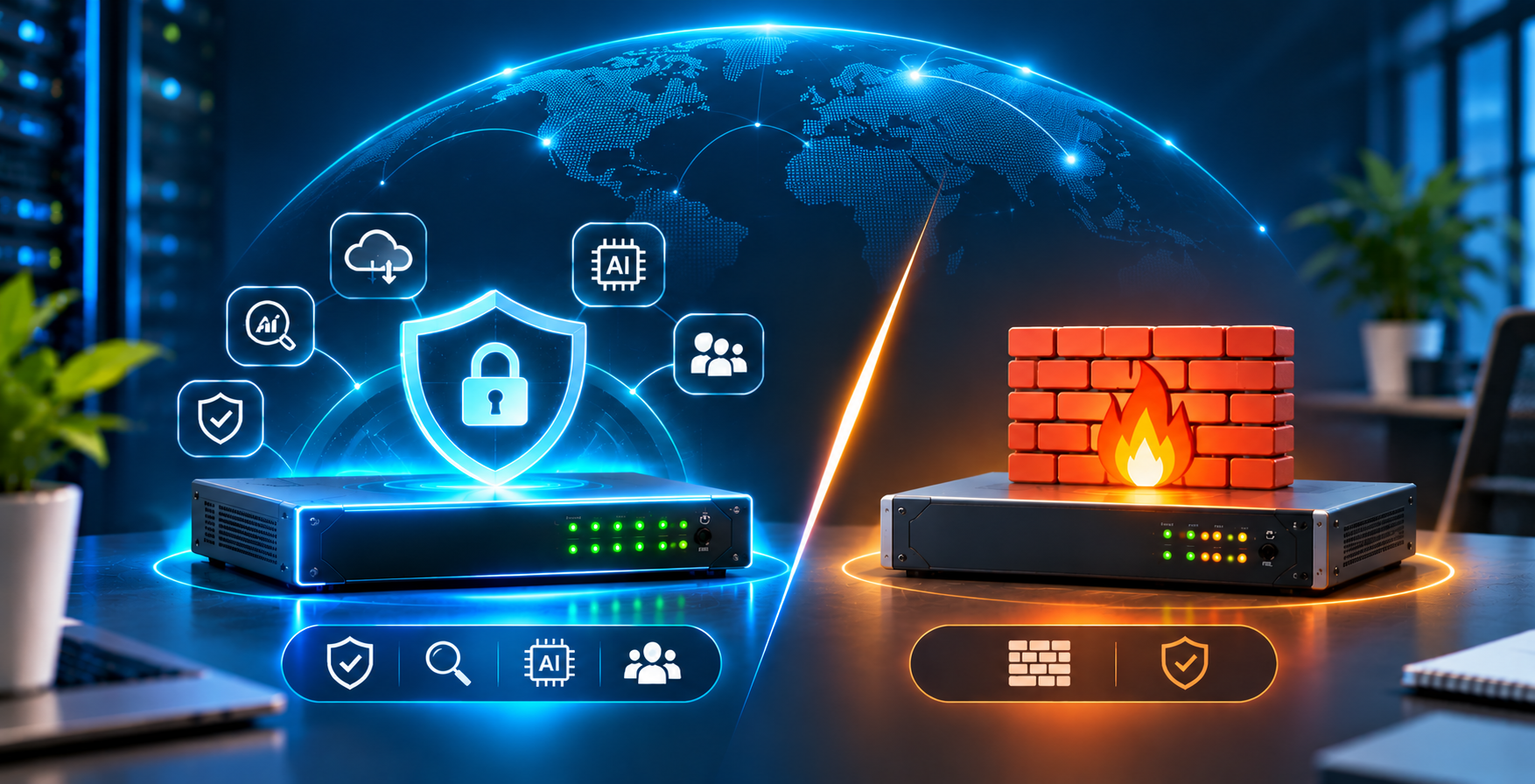
Imagine you are seeing two guards at a theatre. The first guard checks your ticket and lets you in. That's it. The second guard checks what you are carrying in your bag: do you have any gadgets that could enable movie piracy, or any snacks or chewing gum that aren't allowed in the theatre?
The traditional firewall actions will be like the first guard, and the next-gen firewall works like the second guard. Same entrance, different way of checking it, right? This blog helps you to decide which firewall works better for your business needs.
Why This Choice Matters Now
Every threat that attacks the system looks like normal traffic at the entrance.
If you see any URL, every link starts with HTTPS. That means the connection is secured and sealed like an envelope. Nobody in between can read it. It helps with our day-to-day secure data sharing, from online banking to email messaging.
But the problem is that attackers use the same way to enter one's system. Their malware and fake logins bypass the same secure connections your staff uses every day.
How often does this happen? The 2026 Zscaler ThreatLabz Report finds how many attacks were stopped by their cloud in 2025. Their findings concluded that 87% of all malware was encrypted. That is almost nine in ten.
You can ask what the role of a firewall is here. Imagine each connection coming to your server as a sealed envelope. The traditional firewall sees the address on the envelope like web traffic and sees it as legit and passes it. A next-gen firewall can open the envelope and see what's inside it, as it carries any harmful malware that affects the system. Then it seals it again.
Point to consider. That the stats above came from Zscaler's own traffic and not a source from every network on the planet. But the indication is clear. The threats are now hiding in the encrypted traffic.
Traditional Firewall and Next Gen Firewall: How they works?
A traditional firewall takes charge of addresses and ports. It works on some basic rules. In simpler terms, it sees who is requesting something. Where are they going? Which door are they knocking on to enter? They are faster and simpler than the next-gen firewall, and they are predictable.
The newer firewall has all the features of traditional firewalls and has an additional feature in it. It analyzes the traffic. It is able to read which application is running. It easily distinguishes and tells if it's a video call or a file-sharing site, even when both use the same port. It can recognize the attack patterns and block them in the middle of the session.
What a Next Gen Firewall Adds
One Request, Two Different Answers
If one of the staff in a company uploads a client sensitive file to his personal cloud account. The traditional firewall sees web traffic on the port and allows the file to upload. Whereas the newer firewall sees the application and analyzes which user is triggering this response and the sensitivity of the file leaving this device. So It can either block the upload or flag it for inspection.
Catch
Firewalls are not magical. The cost is higher. There are many services that require an annual subscription to receive threat updates regularly. Activating all the services makes the throughput speed slow. Someone has to manage all the additional rules.
A small team or office can't afford that. Buy the box, but do not tune it, and you have paid for a product that you are not using.
Which One Does Your Business Need?
There is no single straight answer for this. The situation decides the need here.
Three Questions to Ask Before You Buy
- How many users can use the network at the same time?
- What will be the speed when the inspection feature is activated?
- Who will be running it on a daily basis?
These questions save time with the salesperson.
Where Redington Online Fits In
Partners usually find it difficult to quote for the right firewall. The straight answer is it starts with the customer's needs. Redington Online helps partners find firewalls from some of the leading brands such as Palo Alto Networks, SonicWall, and Check Point. Our customer support team can help you find the right next-generation firewall for each of your customers.
The traditional firewall checks the ticket. The next-gen firewall checks the ticket, the bag you carry, and even your pockets too. Pick your firewall based on who walks through your entrance. Then decide and configure the right setup for your needs. Point to remember: whether the firewall is traditional or next-gen, every firewall needs to be properly monitored.
Explore More on Redington Online